How Long Does International Moving Take? 2026 UAE Transit & Timeline Guide
MoveConnector Team
Relocation Expert
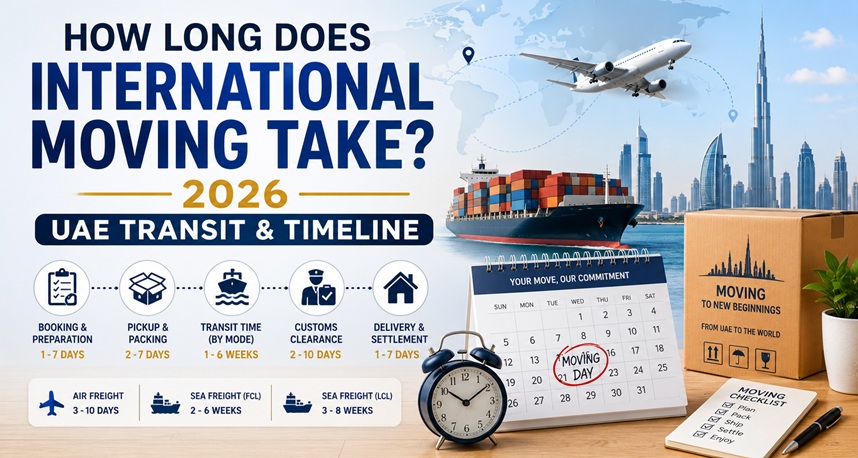
When organizing a global relocation, the primary operational question every expat asks is: how long does international moving take? Understanding the mechanics behind shipping timelines is crucial for budgeting corporate accommodations, coordinating real estate leases, and predicting asset delivery down to the day.
This data-driven manual breaks down average international transit frames out of the UAE, analyzes 2026 maritime structural variables, and highlights spatial packing strategies to keep your calendar secure.
How long does it take to move internationally?
On average, a door-to-door international move from the UAE takes 3 to 6 weeks via air freight and 6 to 12 weeks via sea freight, depending entirely on your destination continent, the custom house clearance procedures at port entry terminals, and current global ocean route factors.
Baseline 2026 Sea Freight Transit Windows (Port-to-Port)
The grid below outlines standard shipping intervals originating from Jebel Ali Port, Dubai:
| Global Destination Region | Estimated Maritime Transit Window | Current Primary Freight Factor |
|---|---|---|
| United Kingdom & Western Europe | 45 – 60 Days | Cape of Good Hope Diversion |
| United States & Canada (East Coast) | 50 – 65 Days | Cape of Good Hope Diversion |
| United States & Canada (West Coast) | 45 – 55 Days | Transpacific Maritime Corridor |
| Australia & New Zealand | 25 – 35 Days | Direct Indian Ocean Service |
| Indian Subcontinent | 10 – 20 Days | Direct Arabian Sea Transit |
| GCC Regional (Saudi Arabia/Oman) | 3 – 7 Days | Cross-Border Overland Trucking |
Why is my international transfer taking so long?
Your international transfer takes longer than historical benchmarks because most major ocean liners operating out of the UAE are routing around the Cape of Good Hope to ensure cargo safety, bypassing the Suez Canal entirely. This mandatory maritime detour appends a mandatory 10 to 14 days of additional open-ocean sailing to standard Europe and North American transit corridors. Please also account for current geopolitical landscapes, port closures, and unexpected regional routing diversions.
Core Variables Inflating Your Delivery Calendar:
- FCL vs. LCL (Shared Containers): If you opt for full container load (FCL) transit, your unit sails directly on the next scheduled vessel. If you choose low-cost Groupage (LCL), your household items sit in a local consolidation warehouse until enough cargo matches the same lane destination, appending 2 to 4 weeks to the front-end timeline.
- Destination Customs Inspection Queues: A border clearance delay can take anywhere from 3 to 14 working days. Randomized agricultural or security scans by agencies like the US Border Protection or UK Customs drastically freeze cargo releases.
- Local Infrastructure Delays: Port congestion at the destination terminal, chassis shortages for overland container trucks, and local driver capacities mean final door delivery can lag even after customs clearance concludes.
What is the hardest room to pack when moving?
The kitchen is universally acknowledged by professional packers as the hardest room to pack when moving. It contains the highest concentration of fragile materials, odd geometric cooking frames, and irregular, high-weight electronic culinary components that demand highly intricate, individualized wrapping protocols.
[Kitchen Packing Timeline Penalty: Requires 3x longer than standard bedrooms]
├── Fragile Dinnerware (Demands custom vertical alignment dish-packs)
├── Variable Metal Cookware (Heavy volumes require dense base consolidation)
└── Sharp Culinary Implements (Requires specialized isolation shielding)
Strategic Rules to Expedite Kitchen Packing:
- Isolate the Bare Minimum: Pack 90% of your kitchen items two weeks before move day, keeping only a tight array of eco-friendly, disposable utensils for survival use.
- Employ True Dish-Pack Cartons: Pack porcelain plates vertically on edge—never lay glassware or plates completely flat, as lateral shocks during rough ocean transits will split flat-stacked crystal.
- Purge Dense liquids: Never pack oils, vinegars, or fluid baking goods. A single temperature expansion burst inside a container will compromise your entire multi-room furniture array.
Your Step-by-Step Relocation Timeline
To make your international move as smooth as possible, break the process down into this simple countdown:
1. Two to Three Months Before: Plan & Get Quotes Decide exactly what you want to take with you and what you will sell or donate. Once you know roughly how much you are shipping, request multiple moving quotes to compare prices and secure your shipping date.
2. One Month Before: Prepare Your Paperwork Make sure your destination visas are approved and passports are up to date. This is the time to apply for any required customs forms (like the ToR1 form for the UK) and fill out your moving insurance documents.
3. One Week Before: Professional Packing Day Your hired moving crew arrives at your home. They will professionally wrap your furniture in heavy-duty materials, build custom wooden crates for fragile items, and create a detailed inventory list of every box for the customs officers.
4. After Moving Day (Weeks 1 to 12): Shipping, Customs, & Delivery Your container is loaded onto the ship. You can track your shipment's progress while it crosses the ocean. Once it arrives at the destination port, your movers will clear it through customs and deliver the items directly into your new home.
Frequently Asked Questions
Why do different international moving estimates show variable transit times?
Estimates show different transit windows because individual moving companies utilize different shipping line alliances. Some providers purchase space on direct express container ships, while lower-cost options rely on transshipment loops, meaning your container is unloaded and reloaded onto secondary ships at intermediate global hubs, increasing risk and delay variables.
How does air freight compare to sea freight timelines?
Air freight takes 3 to 7 total transit days door-to-door, making it vastly faster than ocean lanes. However, air cargo scales explicitly on absolute weight vectors, rendering it economically unviable for heavy structural household items. Expats typically use air cargo for essential personal gear while sending general home furniture via sea lanes.
Is 25 too old to move abroad?
No, 25 is a highly optimal age to move abroad. From a structural logistics perspective, relocating at this career stage usually means managing a lower overall cargo volume, minimizing your international shipping budget down to a highly affordable shared container (groupage) profile.