Diplomatic Moving Services UAE: The 2026 Compliance Guide to Embassy & Mission Relocation
MoveConnector Institutional Desk
Relocation Expert
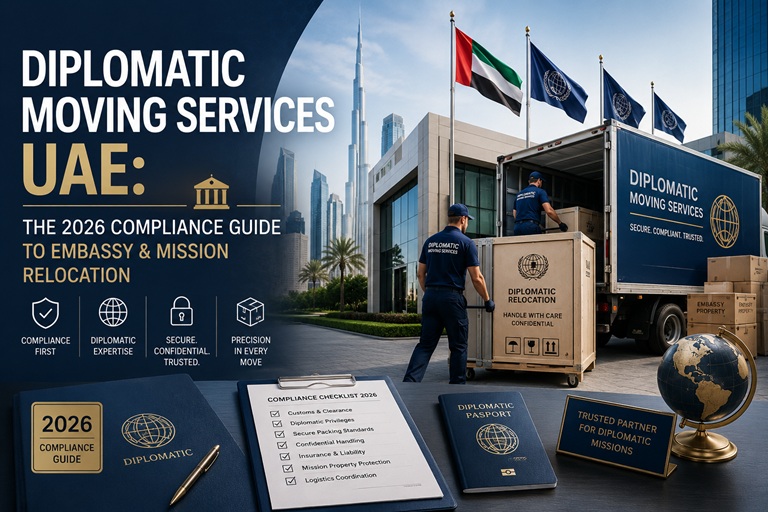
Introduction: The Institutional Protocol for Mission Mobility
Relocating an embassy, consulate, trade mission, or international diplomatic delegation to the United Arab Emirates is a high-security operation governed strictly by international treaties and localized digital systems. In 2026, the consolidation of federal digital logistics networks has streamlined regional operations, but it has also established rigid compliance criteria that tolerate zero administrative errors.
While the Vienna Convention on Diplomatic Relations establishes the foundational framework for cross-border transit, executing an institutional relocation within the Al Bateen (Abu Dhabi) or DIFC (Dubai) diplomatic corridors requires meticulous execution. A single omitted document or an incorrectly logged asset class can cause high-security cargo to stall in unconditioned port terminals, exposing sensitive materials to operational friction.
At MoveConnector, we function as the structural governance layer for specialized logistics. We systematically filter and match international missions with elite, FIDI-FAIM accredited relocation specialists who possess dedicated expertise navigating the Ministry of Foreign Affairs (MOFA) smart customs framework.
🛡️ 2026 UAE Diplomatic Logistics Benchmark
- The Exemption Rule: Used household goods and personal effects enter the UAE with a 100% duty and tax waiver, provided a digitized MOFA Exemption Letter is active
- The Bill of Lading Mandate: The master Bill of Lading (OBL) or Air Waybill (AWB) must explicitly contain the statement "Diplomatic Cargo" to bypass standard commercial sorting pipelines
- The Screening Protocol: Diplomatic immunity does not bypass physical security; virtually all inbound containers are subjected to compulsory X-ray and physical inspection loops by port authorities
- New Item Governance: Any items determined to be brand-new incur a 5% customs duty fee, requiring original commercial invoices to prevent structural fines
1. Navigating the "Diplomatic Franchise" & Documentation Framework
To bypass the standard 5% import duty and accompanying VAT assessments, the target mission must execute a digital "Franchise" application before the physical vessel drops anchor at Jebel Ali Port or Khalifa Port.
Mandatory Documentation Checklist
To clear customs via a diplomatic channel, your designated relocation provider must compile and submit the following structural file:
- Original MOFA Letter: A formal exemption certificate issued online via the Ministry of Foreign Affairs smart portal, embedded with the mission's unique Importer Code
- Declaration of Cargo: The OBL/AWB cleanly marked as "Diplomatic Cargo"
- Comprehensive Inventory: A complete packing list copy detailing every carton's general contents
- Identification Documents: Passport copy of the assigned diplomat alongside verified institutional credentials
- Carrier Clearances: Formal authorization letters issued to the moving company for direct document collection and Delivery Order (DO) releases from the shipping line
Critical Compliance Warning: If shipments arrive at the port before the digital MOFA franchise is completely verified and linked to the customs gateway, authorities will impose a "Deposit Clearance" workflow. This forces the upfront payment of the 5% duty as a cash bond, which can take over 60 days to reclaim through bureaucratic channels. MoveConnector partners prioritize pre-arrival verification to mitigate this financial gridlock.
2. Managing the Physical Inspection & X-Ray Loop
A common point of friction for inbound missions is navigating the physical inspection procedures enforced at UAE ports of entry. According to official FIDI operational guidelines, diplomatic immunity does not exempt household container shipments from physical security verification
Inbound Container ──> Port Security Terminal ──> Mandatory X-Ray Screening ──> Physical Warehouse Inspection ──> Document Reconciliation ──> Final Secure Release
Strategic Packing Framework for Fast-Track Clearing
Because customs officials inspect cargo manually, specific packing structures are required to maintain a high velocity of clearance and protect privacy :
- Media Isolation: All media assets—including books, CDs, videos, DVDs, and printed magazines—must be packed into separate, dedicated cartons
- Explicit Carton Labeling: These specific containers must be explicitly numbered and marked on the inventory manifest This enables customs officials to rapidly identify, spot-check, and clear media items without disrupting the broader shipment
- Handling Cost Management: Be advised that this physical examination framework triggers additional port-enforced warehouse handling fees issued directly by UAE customs and port authorities
3. Commercial Valuation Rules: New vs. Used Effects
The UAE distinction between used personal effects and brand-new consumer assets is strictly enforced by customs inspectors during physical evaluations
The Missing Invoice Penalty Framework
- Used Belongings: Authenticated used household goods and personal effects receive an absolute exemption from customs tariffs
- Brand-New Merchandise: Items determined to be brand-new attract a flat 5% customs duty based on the original CIF/invoice value, plus a 5% VAT assessment calculated directly against the duty amount, plus administrative processing fees
- The USD 300 Penalty: If a customs inspector identifies brand-new items within the shipment and the corresponding original purchase invoice or detailed packing list value is missing, an immediate administrative penalty fee of USD 300 is levied In these instances, customs inspectors will independently assess the financial value of the goods and apply the 5% duty to their own calculated figure
4. Specialized Regulated Cargo: Vehicles and Pets
Motor Vehicle Importation Controls
Diplomatic staff are permitted to import personal transport assets duty-free, provided the technical and administrative parameters meet federal safety specifications:
- Structural Specifications: Vehicles must strictly adhere to UAE standards, featuring original left-hand drive configurations and standard GCC compatibility metrics
- Detailed Manifesting: The master Bill of Lading must explicitly specify technical details including the exact engine number, chassis number, make, model, and color
- Ownership and Frequency Boundaries: Importers must present authenticated proof of ownership from the country of origin (such as a vehicle title deed) Importation is rigidly capped at one vehicle per diplomat per year, and the vehicle must be completely de-registered with the origin traffic authority prior to shipping
- Registration Conversion: Once cleared, the authority issues a Vehicle Clearance Certificate (VCC), which is used alongside MOFA clearance to secure the official blue diplomatic license plates via local traffic departments
Pet Relocation Protocols
If diplomatic personnel are relocating with pets, the process requires explicit advance scheduling to align with UAE regulatory timelines:
- Quantity Limits: Private individuals are permitted a maximum of 2 pets per shipment, whereas commercial entities or accredited moving agents face no quantity restrictions .
- Age and Health Restrictions: The UAE completely prohibits the importation of any dogs or cats under 4 months of age For first-time rabies vaccinations or instances where vaccination continuity was broken, a strict 21-day waiting period must pass post-vaccination before the animal can legally cross into the UAE .
- Pre-Flight Permitting: All core documentation—including the original Export Health Certificate, Rabies Serum Neutralization Test records, and complete vaccination history—must be routed to your destination agent two to three weeks before the flight This enables the local agent to secure a formal Import License valid for exactly 30 days, which must be attached directly to the Air Waybill (AWB) .
- Banned Breeds: Ensure the diplomat's household is not attempting to import restricted breeds, as pit bulls, mastiffs, staffordshire terriers, and related guard breeds are entirely banned from entry .
5. Prohibited, Restricted, and Censored Items
To avoid severe legal repercussions, diplomatic shipments must filter out prohibited materials at the origin residence before loading and container sealing occur.
Prohibited Commodities Matrix
The discovery of any of the following items inside an inbound container results in immediate asset confiscation, severe institutional fines, and potential legal or diplomatic friction :
| Category | Prohibited Items (Absolute Ban) |
|---|---|
| Weapons & Tactical | Real or ornamental firearms, live ammunition, firecrackers, combat swords, tactical daggers, spears, and official military uniforms or combat gear |
| Controlled Substances | Narcotics of all classifications, poppy seeds (including flowers/leaves), and unapproved pharmaceutical drugs |
| Cultural & Religious | Sculptures or figures of animals possessing explicit religious undertones, human sculptures or carvings featuring nudity, gambling apparatus, and controversial political or religious literature contrary to Islamic principles |
Restricted Items Requiring Secondary Institutional Clearance
Certain assets can be imported but will be detained at the border until specific ministry sign-offs are produced :
- Censorship Controls: All personal records, tapes, films, photographs, periodicals, and books are subject to a detailed compliance review and censorship vetting process executed by the Ministry of Information, a protocol that can extend clearance timelines by 10 to 15 business days
- Unmanned Aerial Vehicles: Drones cannot clear customs without a validated license issued directly by the Dubai Civil Aviation Authority .
- Printed Material & Literature: Inbound shipping of corporate brochures or specialized advertising leaflets requires explicit authorization from the National Media Council .
6. Why Global Missions Route Logistics via MoveConnector
Managing a diplomatic asset relocation requires an intermediary layer that enforces total quality and compliance. Booking randomly via unvetted local suppliers introduces security liabilities. MoveConnector mitigates this risk by acting as an algorithmic audit layer.
Operational Capacity Comparison Matrix
| Operational Capability | MoveConnector Diplomatic Infrastructure | Standard Commercial Moving Providers |
|---|---|---|
| Network Accreditation | Exclusively FIDI-FAIM / IAM certified international operators | Mixed networks with unverified international subcontractor tiers. |
| Customs Integration | Native execution of digitized MOFA smart portal workflows | Standard commercial freight experience lacking diplomatic nuance. |
| Crew Vetting Standard | Secondary background-checked packing specialists with secure embassy compound clearance. | Freelance daily labor tiers lacking verified institutional clearances. |
| Audit Compliance | Itemized inventory logging matching global governmental auditing criteria. | Manual, unstructured manifesting prone to border classification errors. |
Secure Your Mission's Relocation Protocol
A diplomatic relocation is an exercise in operational security and legal compliance. Do not allow administrative oversight to compromise your mission's timeline or data integrity. MoveConnector aligns your high-security logistics parameters with the UAE's most accomplished, accredited diplomatic moving specialists.
Initiate a Confidential Consultation with Our Institutional Relocation Desk